Home // HOW I WORK // METHOD

Method and chain of custody

The summary is on the home page; here is the full protocol: what happens at each stage, how custody is materialised, and the standards that sustain it.

How I work · 2 of 4
The six stages

From first contact to post-report support, all documented

The six steps summarised on the home page are, in practice, a complete protocol. Below is what happens at each stage and what you receive at the end of each one.

Stage 01

Initial assessment of the case

A no-cost consultation to understand the nature of the dispute, the objectives and the available evidence. This is where the most important question is answered before any spending: does the argument have technical support? The assessment is frank both ways, including when the recommendation is not to run an examination. Cases with a procedural deadline approaching or an incident under way get priority in response.

Stage 02

Technical and commercial proposal

A formal document with scope, planned methodology, deadlines and fees, priced case by case: fixed fees or technical hourly rate. The confidentiality agreement (NDA) is signed before any analysis, and the conflict of interest check happens at this stage. Nothing starts with a handshake: what will be done is put in writing before it is done.

Stage 03

Forensic collection and preservation

The heart of the chain of custody: receipt photographed and described, numbered seal, acquisition with write blockers and hardware duplication producing a bit-for-bit forensic image, with the hash calculated during the acquisition itself. Mobile devices are isolated from the network immediately. When the evidence sits in another city or country, assisted remote collection documents every step of the session.

Stage 04

Technical analysis in the laboratory

Every examination runs on the copy, never on the original, which waits in a certified vault room (ABNT NBR 15247 / EN 1047-2) with restricted access. Dedicated servers index and correlate the data; alternative hypotheses are tested and ruled out in writing; the limitations of the examination are stated before the conclusion. Recognised forensic tools, with the version recorded in the report.

Stage 05

Delivery of the expert report

The final instrument states the methodology, documents the chain of custody, answers the questions to the expert point by point and presents the conclusions in language the court follows without an interpreter. ICP-Brasil digital signature, delivery media finalised as read-only and a verification hash: either party can check the integrity of what it received.

Stage 06

Post-report support

The work does not end at filing: written clarifications, supplementary submissions, attendance at hearings and technical defence of the report against challenge. Whoever signs it defends every conclusion in person, before any instance where it is questioned.

Deliverables and timing

What you receive, and how soon

The proposal at stage 02 already states which instrument the case will receive. There are four, from the fastest to the most complete. All follow the same method of preservation and examination. What changes is the depth and the use the document will have.

Preliminary

Technical Report

The first technical reading, for a quick internal decision: what happened, what is already demonstrated and what still needs examination. Reference timeline: 3 to 5 business days.

Narrow scope

Simplified Technical Opinion

Answers a closed set of questions. It serves, for example, to give technical support to the response a company files with the Central Bank of Brazil or the CVM (Brazil's securities commission). Reference timeline: 20 to 30 days.

Internal decision

Administrative Technical Opinion

Deeper, for information security and compliance decisions: internal inquiry, dismissal, disciplinary measure, review of controls. Reference timeline: 20 to 30 days.

Lawsuit

Expert Report (full/judicial)

The complete instrument, for civil, labour or criminal proceedings and to support the incident notification to the ANPD (Brazil's data protection authority). When the case requires it, it includes the recovery of deleted data. It meets the requirements of the proceedings. Reference timeline: normally 30 to 60 days; up to 90 days in highly complex cases; exceptionally, within 30 days.

Reference timelines
1 to 2 business daysStart of preservation
24 hoursCustody record of the material
24 hoursReview of the draft notarial deed
3 to 5 business daysTechnical Report
20 to 30 daysSimplified Technical Opinion and Administrative Technical Opinion
30 to 60 daysExpert Report, normally; exceptionally, within 30 days; up to 90 days in highly complex cases

Timelines are a reference, not a promise. The schedule of each case is set out in the proposal, by milestones, according to the number of devices and the volume of data. When a procedural deadline or the risk of losing the evidence requires it, the examination is also carried out outside business hours, scheduled case by case. What each instrument contains is described in Expert Reports and Opinions.

Batch triage

Many devices, a report only where there is a trace

When the suspicion may lie in any one of dozens of computers, examining all of them in depth consumes time and does not help the case. Batch triage solves this in two phases.

First, broad preservation. Every device in scope is copied on site, with write blocking and hash. This is the phase that most demands the expert in the field, and it is what guarantees that no evidence is lost while the analysis moves forward.

Then the analysis goes through the preserved images looking for traces of the fact, at administrative level. Only the devices with a positive result move on to in-depth examination and to the Expert Report. The others remain preserved and in custody.

The gain is avoiding fruitless examinations, which serve none of the client's goals: recovering the loss, understanding the incident to prevent the next one, or establishing authorship and holding those involved accountable.

REAL CASE · ANONYMISED

Offensive messages and dozens of computers

Challenge. Offensive messages had been posted on an organisation's messaging application, and any one of dozens of computers could be the source.

Method. All of them were preserved and analysed at administrative level; only the positive ones went on to judicial examination.

Outcome. The full examination and the report were confined to the machines that carried a trace, with no examination of equipment that had nothing to show.

Chain of custody

The full history of every trace

Chain of custody is the traceable record of everything that happened to the evidence: who touched it, when, with which tool and for what purpose, from receipt to the outcome of the case. The concept entered Brazil's Code of Criminal Procedure (CPP) through Law 13,964/2019 (arts. 158-A to 158-F), and the courts apply it with growing rigour to digital evidence: material accessed before examination, with no hash and no seal, has been held unusable.

In laboratory practice, this takes the form of verifiable gestures: every interaction with the material has an author, date, time and purpose noted down; the examination runs on the forensic image authenticated by hash; the original stays sealed in the vault room; and the delivery media goes out read-only. Any forensic expert, including the one appointed by the opposing party, can retrace the path and reach the same verification.

It is this reproducibility that decides the fate of a report in court. The CPC, art. 479 (Brazilian Code of Civil Procedure) reminds us that the judge is not bound by the expert report; what persuades is the method demonstrated. And the fruit of the poisonous tree doctrine cuts the other way: evidence contaminated at source contaminates everything derived from it. Between those two threads, the chain of custody is what keeps the evidence standing.
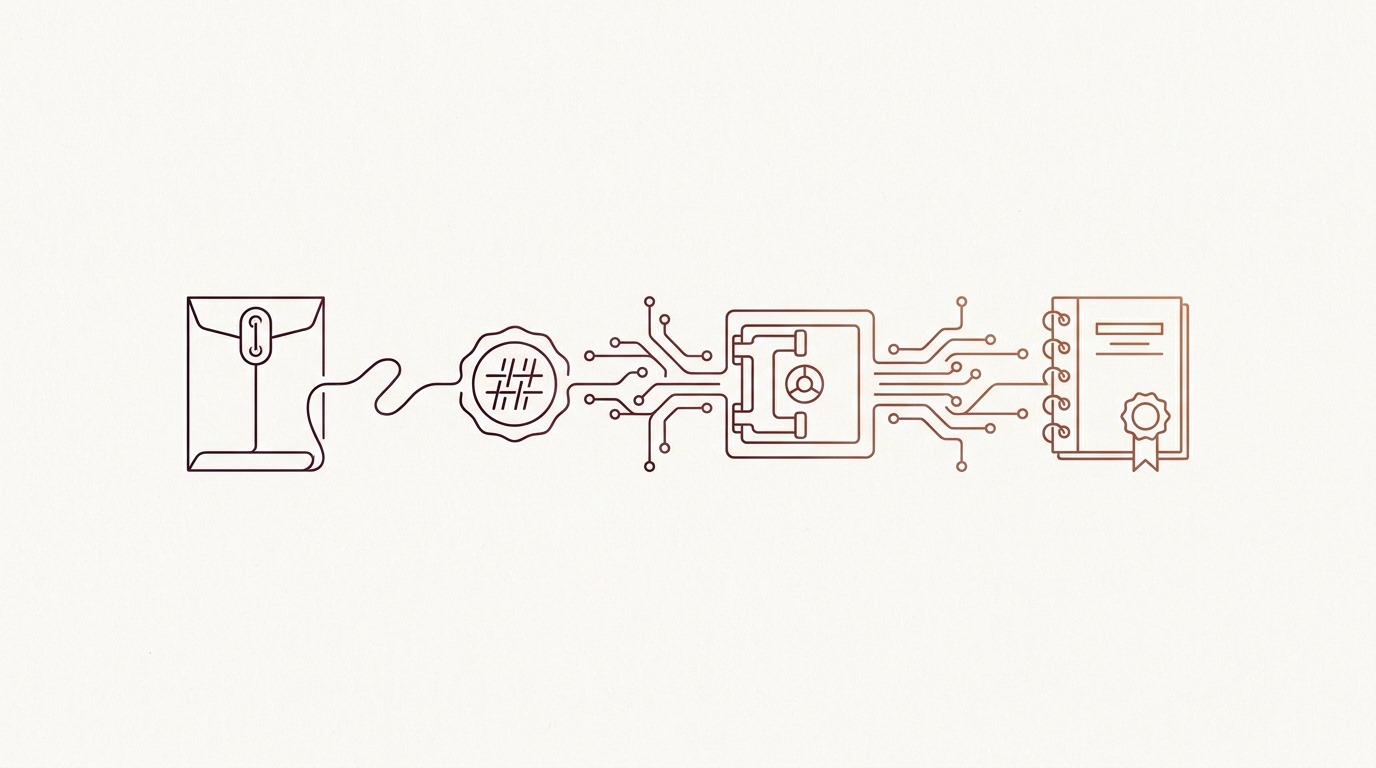
ReceiptPhotographed and described, with a numbered seal and identifiers on record
AcquisitionWrite blocker + hardware duplication, hash calculated on the spot
ExaminationOn the copy only; alternative hypotheses tested, limitations stated
StorageCertified vault room, restricted access and continuous monitoring
DeliveryReport with ICP-Brasil, read-only media, verification hash
Audit trailEvery handling recorded: author, date, time and purpose
The chain of custody flow: from the seal to the vault room and the expert report
Preservation

The evidence lost before the expert arrives

The most common mistake does not happen in the laboratory. It happens at the company, on the day of the suspicion: the IT department switches the computer on to "take a look". Every access writes new records and changes file dates. By the time the forensic examination arrives, it is no longer possible to separate what the person under investigation did from what IT did afterwards. The script of what to do and what to avoid in the first hour is in For Companies.

REAL CASE · ANONYMISED

The dismissal for cause that fell because of the internal examination

Challenge. A director was suspended after a report of access to inappropriate content at work, and his computer was handed over to the technology department. After days of attempts, the IT team found the accesses, and he was dismissed for cause.

Method. In the labour claim, the forensic examination reconstructed the timeline of the device.

Outcome. The accesses had taken place after the computer was handed over to IT, during the internal examination itself. The dismissal for cause was reversed, and the case unfolded into a claim for damages to the executive's reputation.

The protocol

The right preservation

The right path is the protocol described above: original sealed, forensic image with hash and examination on the copy only. Any forensic expert, including the one appointed by the opposing party, can check that the original has not changed.

External audit

Notarial deed, where appropriate

When collection takes place on site and the evidence is likely to be disputed, it is worth adding a notarial deed. The deed drawn up by a notary attests the existence and the manner of existence of a fact, including data recorded in electronic files (CPC, art. 384 and sole paragraph). The notary witnesses the collection and the duplication of the media, and the deed comes to work as an audit of the technical procedure.

The notary records. Who says what needs to be recorded is the expert: the devices and the media, the seals, the hashes, the times, who was present and every step of the copy. An incomplete deed is the gap the opposing party looks for years later. The expert's review of the draft is delivered within 24 hours.

Degree of conclusion

What the report states, what it infers and what is still a hypothesis

An expert report only states what the expert was able to demonstrate. That is why a proven fact carries no label: what is written as a conclusion was verified in the trace. When the reasoning goes beyond what the trace shows directly, the report says so, with one of two classes.

Indirect conclusion

Inferred

A conclusion drawn from other evidence, when there is no direct record of the fact. Example: there is no record of the moment of copying, but the dates of the files on the USB drive and the connection log of the device, taken together, place the copy within a time window. The report shows the chain of reasoning, so the reader can check where the conclusion came from.

Hypothesis

Speculative

A hypothesis the material does not yet support, but which opens a new line of analysis. It appears identified as such and guides the next examination, which will confirm or discard it. It is never presented as a conclusion.

A discarded hypothesis usually falls into one of two categories: the false positive and the illusory trace. There is a third, more serious, which the expert must be ready to find: the forged trace. These are the three traps the examination takes apart.

Coincidence

False positive

The clue that seems to point at someone, but does not: a coincidence of time, a contact in common, a keyword in the wrong place. In large volumes of data, coincidences always appear, and each one is tested against the alternative explanation. It was this test that cleared a person accused in a case with thirteen devices.

Unrelated to the fact

Illusory trace

The record exists, but has no relation to the fact under investigation. It was produced by another cause: an automatic system routine, an update, cloud synchronisation or the handling of the device after the fact, as in the IT case above. The examination identifies the origin of each record before attributing it to anyone.

Manipulation

Forged trace

The trace was created or altered on purpose, to hide the action or to point another way: modified file dates, records deleted and recreated, a trail planted to incriminate a third party. The author may be an external attacker or someone inside the company. It is not a textbook hypothesis: it has already appeared in cases handled by the laboratory. Manipulation also leaves a mark, and the report describes it as a finding.

Methodology

The standards behind every examination

National scope
ISO/IEC 27037Identification, collection, acquisition and preservation of digital evidence
ISO/IEC 27041Assurance of the suitability of investigative methods
ISO/IEC 27042Analysis and interpretation of digital evidence
ISO/IEC 27043Incident investigation principles and processes
CPP art. 158-AChain of custody in criminal proceedings (Law 13,964/2019)
CPC art. 156 et seq.Expert evidence in civil proceedings
Marco Civil / LGPDBrazil's internet framework and data protection act applied to digital evidence
NIST / SWGDETechnical references for forensic procedure adopted in Brazilian practice
International scope
GDPREuropean Union, in cases involving data of European subjects
eIDASElectronic signatures and identification in the European Union
PIPEDA / Law 25Canada, in local operations and disputes
CCPA / HIPAAUnited States, according to the sector of the case
LATAM data lawsArgentina, Chile, Uruguay, Paraguay and Mexico
ISO/IEC 27050e-Discovery in cross-border disputes

How international work is handled →

Explore the working method · step 2 of 4

That is the method. Now see the laboratory where it happens.

Next: Laboratory →

The technical evidence your case requires. The authority courts respect.

Initial feasibility consultation at no cost. Reply within 24h on business days.
Request an Examination